
The 1929 crisis, commonly known as the Wall Street Crash or the Great Crash of 1929, occurred during a period of significant economic and social change. During the Roaring Twenties, also referred to as the “Jazz Age,” the United States experienced remarkable economic growth following the First World War (1914-1918). Industrialisation, technological advancements, and the expansion of consumer markets propelled the American economy to unprecedented levels.
Massive Industrialisation: Large corporations, especially in sectors such as automotive (e.g., Ford) and manufacturing, grew rapidly.
Expansion of Credit: New, accessible financing methods allowed citizens to incur debt to purchase goods such as cars, household appliances, and, crucially, stocks on the stock market.
Widespread Optimism: Confidence in the market was so high that many believed stock prices would only increase, encouraging more individuals to invest.
However, this growth was built on weak economic foundations, which eventually led to the inevitable collapse.
Speculation involves investors purchasing assets with the hope of selling them later at a higher price. During the 1920s:
Many investors began buying stocks with the expectation of quick profits.
Stock prices became overinflated, far exceeding the real value of the underlying companies. This created a speculative bubble, where prices rose artificially due to heightened demand.
Access to cheap credit enabled many individuals and investors to buy stocks on margin. This meant they could pay only a fraction of the stock’s value with their own money, borrowing the remainder.
If stock prices rose, investors could sell their shares, repay the loans, and secure a profit.
However, if prices fell, investors were unable to cover their debts, leading to massive losses.
In October 1929, several investors began selling their stocks, sensing that prices were overvalued. This triggered:
Black Thursday (24 October): 12.9 million shares were traded, further exacerbating the market’s decline and increasing pressure on investors.
Black Tuesday (29 October): The market collapsed entirely, with a dramatic drop in stock prices, marking the onset of a deep economic crisis that reverberated worldwide.
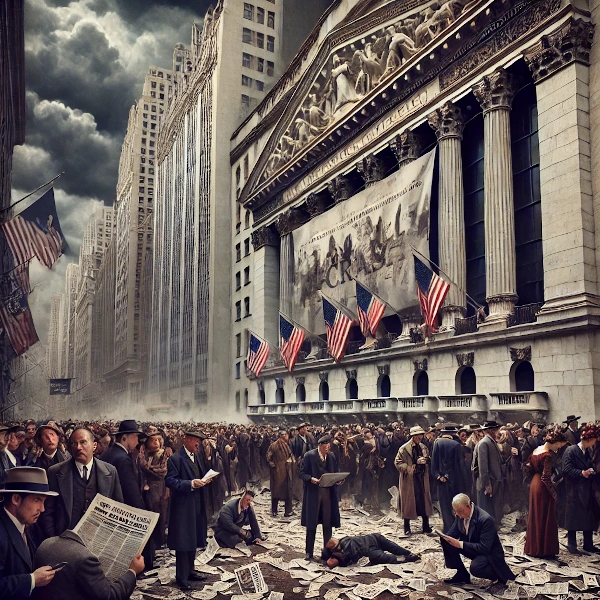
Mass Bankruptcies: Countless individuals and businesses went bankrupt as they could not repay their debts.
Unemployment: Businesses began shutting down, leading to a sharp rise in unemployment rates.
Loss of Confidence: The market’s collapse caused a profound loss of trust in the financial system.
The 1929 crisis was the catalyst for the Great Depression, a decade-long global economic downturn with widespread consequences:
Decline in International Trade: Nations imposed protectionist tariffs, reducing global trade.
Global Unemployment: Unemployment rates soared in Europe and the United States.
Political and Social Changes: The crisis led to new economic policies, such as Franklin D. Roosevelt’s New Deal in the United States.
The 1929 crash not only devastated the United States but also had far-reaching effects on the global economy, impacting Europe and developing nations alike:
Europe and the Withdrawal of American Credit: Europe, still recovering from the debts and destruction of the First World War, was heavily reliant on American loans and capital flows. Following the Wall Street Crash, U.S. banks withdrew foreign funding, leading to the collapse of European banks and key industries. Countries such as Germany and the United Kingdom faced severe recessions, exacerbated by protectionist policies like the Smoot-Hawley Tariff.
Crises in Commodity-Exporting Countries: Nations in Latin America, Africa, and Asia, dependent on the export of products such as coffee, rubber, and oil, experienced dramatic price drops for their goods. This led to deep recessions, widespread unemployment, and social unrest.
Restructuring of the Global Financial System: The crash exposed the fragility of the international financial system, prompting changes such as the abandonment of the gold standard by several nations. These shifts paved the way for the creation of institutions like the International Monetary Fund (IMF) and the World Bank in later decades.
The 1929 crash transformed not only national economies but also the global economic structure, highlighting the interconnectedness of international markets.
The Wall Street Crash of 1929 was the collapse of the New York Stock Exchange that occurred in October 1929. It marked the beginning of the Great Depression, a global economic crisis that lasted over a decade. During the crash, stock prices plummeted dramatically, bankrupting investors and banks.
The causes of the 1929 Crash include excessive speculation in the stock market, the widespread practice of buying shares on credit (margin trading), overproduction in both industrial and agricultural sectors, and growing economic inequality. These factors created an unsustainable financial bubble, which ultimately burst in October 1929.
📉 The Wall Street Crash primarily took place on 24 October 1929, known as Black Thursday, followed by 29 October 1929, known as Black Tuesday, when stock prices collapsed catastrophically.
The 1929 Crash triggered a global economic crisis. The U.S. economy collapsed, international trade contracted dramatically, and many countries faced widespread unemployment, bankruptcies, and severe poverty.
The main consequences of the 1929 collapse included a global GDP decline, millions of people unemployed, widespread bank and business closures, loss of savings, and a humanitarian crisis that affected all social levels.
The Great Depression began in 1929 and lasted until the end of the 1930s. In the United States, full recovery was achieved with World War II in the 1940s.
The United States recovered through the New Deal, a set of policies implemented by President Franklin D. Roosevelt that included banking reforms, employment programs, and infrastructure projects. World War II further boosted the economy with a surge in production.
The 1929 Crash was the catalyst that triggered the Great Depression, a global economic crisis that spanned the 1930s and affected millions of people worldwide.
This version highlights the key points concisely and clearly, while using terminology suited to an expert audience.
The Smoot-Hawley Tariff Act, officially known as the United States Tariff Act of 1930, was a U.S. trade law enacted in June 1930 with the goal of protecting domestic industries by sharply increasing tariffs on thousands of imported goods. It was sponsored by Senator Reed Smoot and Representative Willis C. Hawley.
Although intended to support American farmers and manufacturers, the law had significant negative consequences:
Sources:
Encyclopaedia Britannica – Smoot-Hawley Tariff Act
Library of Congress – Smoot-Hawley Tariff
Wikipedia – Smoot-Hawley Tariff Act
Are you interested in learning more about Wall Street?
Don’t miss our dedicated page to this iconic financial district. Discover it here: Wall Street ¡¡