
St. Patrick’s Cathedral, located in Midtown Manhattan on Fifth Avenue, is one of New York City’s most iconic religious and architectural landmarks. This Neo-Gothic cathedral is not only the largest Catholic church in the United States, but also a symbol of the deep-rooted Catholic heritage in American history. Just across from Rockefeller Center, it welcomes millions of visitors each year—pilgrims, architecture enthusiasts, and curious tourists alike.
With 21 altars and 19 bells housed in its north tower—each dedicated to a different saint—St. Patrick’s Cathedral blends spiritual significance with artistic grandeur. Its towering spires, intricate stained glass windows, and ornate façade make it one of the most photographed and admired churches in New York. Whether you’re seeking a moment of peace or marveling at its historic design, the cathedral offers a unique glimpse into the religious and cultural soul of the city.
The cathedral features 21 altars and 19 bells in its north tower, each dedicated to a different saint. Beyond its role as a center of faith, it stands out for its magnificent architecture and is widely regarded as one of New York’s most beautiful churches
The history of St. Patrick’s Cathedral dates back to the mid-19th century, a time when New York City was experiencing rapid growth. As the Catholic population, mostly composed of Irish immigrants, increased, the need for a larger, more modern cathedral became evident.
The cornerstone of the cathedral was laid on August 15, 1858, during the administration of the then Archbishop of New York, John Hughes, a staunch supporter of the Irish Catholic community. The design was created by architect James Renwick Jr., who adopted a Gothic Revival style, popular in Europe at the time, but with unique touches tailored to meet the needs of the city.
Construction was delayed for several years due to economic difficulties and the American Civil War. The cathedral was finally completed and inaugurated in 1879. While it was initially dedicated to the Sacred Heart, it eventually became the main seat of the Archdiocese of New York.
Designed in the mid-19th century to replace the old St. Patrick’s Cathedral as a place of worship for the growing Catholic community of New York, it remains the seat of the Archbishop of the Roman Catholic Archdiocese of New York.
St. Patrick’s Cathedral is a magnificent example of Gothic Revival architecture, a style that revived medieval forms for church construction in the 19th century. Inspired by European Gothic cathedrals, its design features unique elements that set it apart within the American architectural landscape.
Among its most impressive features are the stained glass windows, the inlaid marble tabernacle, the historic pipe organs, and the beautiful sculpture of the Pietà.
St. Patrick’s Cathedral is a prominent example of the Gothic Revival style, which was inspired by medieval architecture and adopted in both Europe and the United States during the 18th and 19th centuries. This style was associated with the Romantic Middle Ages, reflecting admiration for the ancient Gothic cathedrals of Europe. During this period, there was a strong push for the construction of churches and public buildings, with St. Patrick’s Cathedral standing as one of the finest examples in New York.
In the American context, the transition from Neoclassicism to Gothic architecture was driven by several factors, including literary romanticism, the influence of authors like Sir Walter Scott, and the desire to reflect a moral identity through religious architecture. The influence of this style remained strong in the structures of the era, leaving a legacy that is reflected in the grandeur of buildings like St. Patrick’s Cathedral, a symbol of the union between art, faith, and history.
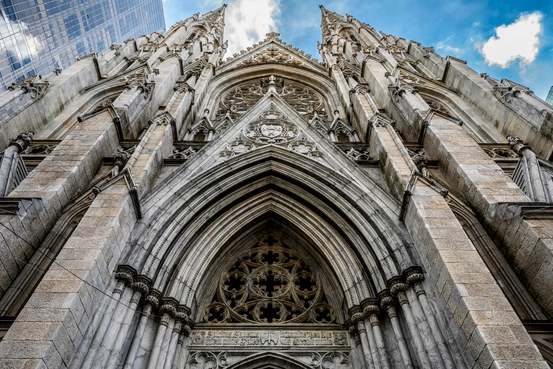
The façade of the cathedral, which stretches along Fifth Avenue, is dominated by two impressive towers reaching 100 meters in height. These towers, inspired by those of the Chartres Cathedral in France, evoke the European Gothic roots, making them an architectural landmark in New York.
At the center of the façade is a stained glass rose window depicting the Fleur-de-lis, a symbol of the purity of the Virgin Mary. In addition, the bronze doors, added in 1949, each weigh over 4 tons and are adorned with detailed representations of biblical scenes.
The main door is decorated with sculptures depicting biblical scenes, while the three side doors feature reliefs of Saints and Angels. In total, the cathedral’s exterior is adorned with over 2,500 sculptural figures, making it one of the most ornate cathedrals in New York.

Upon entering St. Patrick’s Cathedral, visitors are immediately struck by the grandeur of its central nave, which reaches a height of 37 meters. The interior design follows the traditional layout of Gothic cathedrals, with slender columns rising toward the ceiling and a series of side chapels that provide a place for intimate reflection of faith.
One of the most notable features of the interior is the main altar, located at the head of the nave. Surrounded by colored stained glass windows, this altar stands as a symbol of the sacrifice of Christ. The stained glass windows are another prominent feature of the cathedral, with more than 200 panels depicting scenes from the Old and New Testaments, as well as the lives of the saints.
The white stone from Connecticut, used in the construction, reflects the light in a way that the interior is gently illuminated throughout the day, creating an atmosphere of serenity and spirituality.
St. Patrick’s Cathedral is not only a place of worship but also an important cultural and social hub. As the seat of the Archdiocese of New York, it hosts daily Masses and a well-attended Sunday service. During major religious holidays, such as Holy Week and Christmas, the cathedral fills with both worshippers and tourists who participate in the solemn celebrations.
One notable event is the Mass on St. Patrick’s Day, celebrated every March 17th. On this day, dedicated to the patron saint of Ireland, thousands of people, many of Irish descent, gather at the cathedral. This tradition not only highlights the religious significance of the place but also its deep connection with the Irish community, reflecting New York’s multicultural history.
The St. Patrick’s Cathedral has undergone several renovations throughout its history, especially in the 21st century. In 2015, a multimillion-dollar restoration project was carried out, which renovated its façade, reinforced its structure, and restored key elements such as sculptures and stained glass windows, returning it to its original splendor.
The project also included the restoration of the bronze doors from 1949, which weigh more than 4 tons each and are decorated with biblical scenes. Thanks to these interventions, the cathedral has managed to preserve its original appearance, solidifying its place as one of New York’s architectural gems.
The work not only preserved its design but also ensured that the cathedral remains an active place of worship. This balance between conservation and functionality has allowed it to maintain its status as an architectural and cultural treasure, attracting both tourists and worshippers. The effort to preserve this monument guarantees that its legacy endures as a symbol of New York’s religious and cultural heritage.
The cathedral’s towers, inspired by the Chartres Cathedral, ensure that St. Patrick’s Cathedral remains an icon of religious architecture in New York.
The St. Patrick’s Cathedral is located on Fifth Avenue, between 50th and 51st Streets in Manhattan, right across from the Rockefeller Center.
It is open to the public every day, and entry is free.
Mass schedules vary, but generally, services are held every hour during weekdays, with special services on weekends.